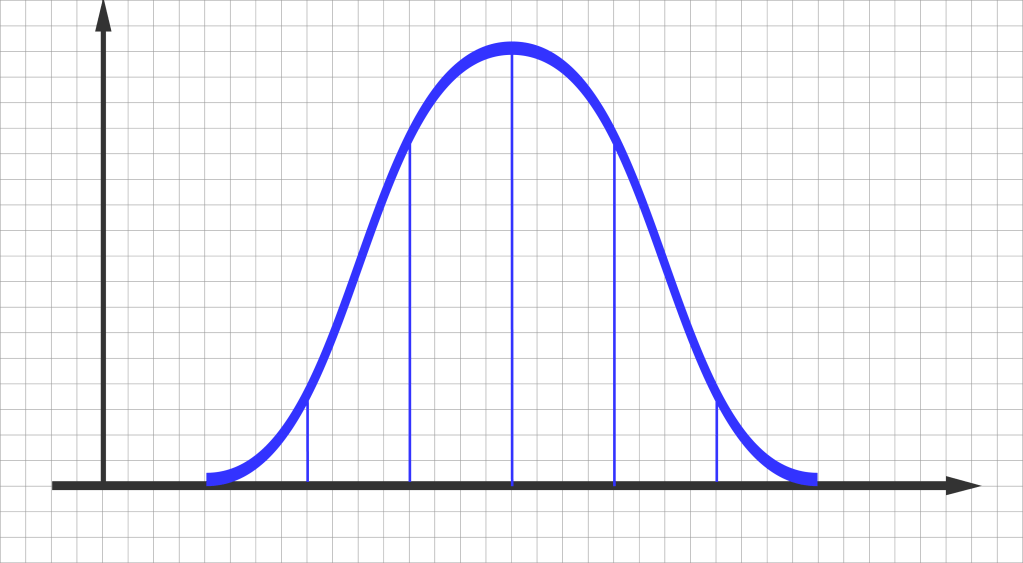
In the realm of statistics and finance, one term that often makes its way into discussions about risk and probability is “kurtosis.” But what exactly is kurtosis, and why does it matter in the world of investments? Let’s delve into the intricacies of kurtosis, exploring its mathematical underpinnings, its implications for probability distributions, and its significance in financial risk management.
Defining Kurtosis: The Fourth Central Moment
At its core, kurtosis is a statistical measure that provides insights into the shape of a probability distribution. Specifically, it is the standardized fourth central moment of a random variable. In simpler terms, it quantifies the likelihood of extreme positive or negative events occurring relative to the mean of a dataset.
Mathematically, for a random variable X with a mean (μ) and standard deviation (σ), the kurtosis (K) is defined as:
K=E[(X−μ)4]σ4K=σ4E[(X−μ)4]
Where:
- EE denotes the expected value.
- (X−μ)4(X−μ)4 represents the fourth power of the deviation from the mean.
Understanding Fat Tails: Leptokurtosis and Platykurtosis
The kurtosis of a normal distribution is always three. This baseline is a useful reference point. Excess kurtosis, defined as kurtosis minus three, is a key concept. Distributions exhibiting positive excess kurtosis are termed “leptokurtotic,” indicating fat tails and a higher probability of extreme events. Conversely, distributions with negative excess kurtosis are labeled “platykurtotic,” suggesting thinner tails and a reduced likelihood of extreme events.
Implications in Finance: Risk Preferences and Hedge Fund Strategies
In the world of finance, investors tend to gravitate towards investments with lower kurtosis. Why? Lower kurtosis implies a more predictable, less volatile distribution of returns. However, the reality is that the returns of many securities, and certain hedge fund strategies in particular, do not adhere to the normal distribution’s kurtosis of three.
Hedge fund managers, dealing with strategies that might display high levels of kurtosis, use risk management techniques to mitigate potential downsides. Understanding the excess kurtosis of a portfolio helps managers assess the likelihood of extreme events and tailor risk management strategies accordingly. By doing so, they aim to bring a semblance of predictability to the inherently unpredictable world of financial markets.
Conclusion: Navigating the Fat Tails
In conclusion, kurtosis serves as a valuable tool for assessing the shape and risk profile of probability distributions. The concept of excess kurtosis, whether positive or negative, unveils the likelihood of extreme events—be they financial windfalls or pitfalls. For investors and hedge fund managers alike, a nuanced understanding of kurtosis provides a means to navigate the fat tails of probability distributions and, in turn, make more informed decisions in the dynamic landscape of finance.
 ZestFi